Material notes
The amber guide.
Amber is fossil resin, not a stone. Here is what that means for colour, weight, inclusions and care.
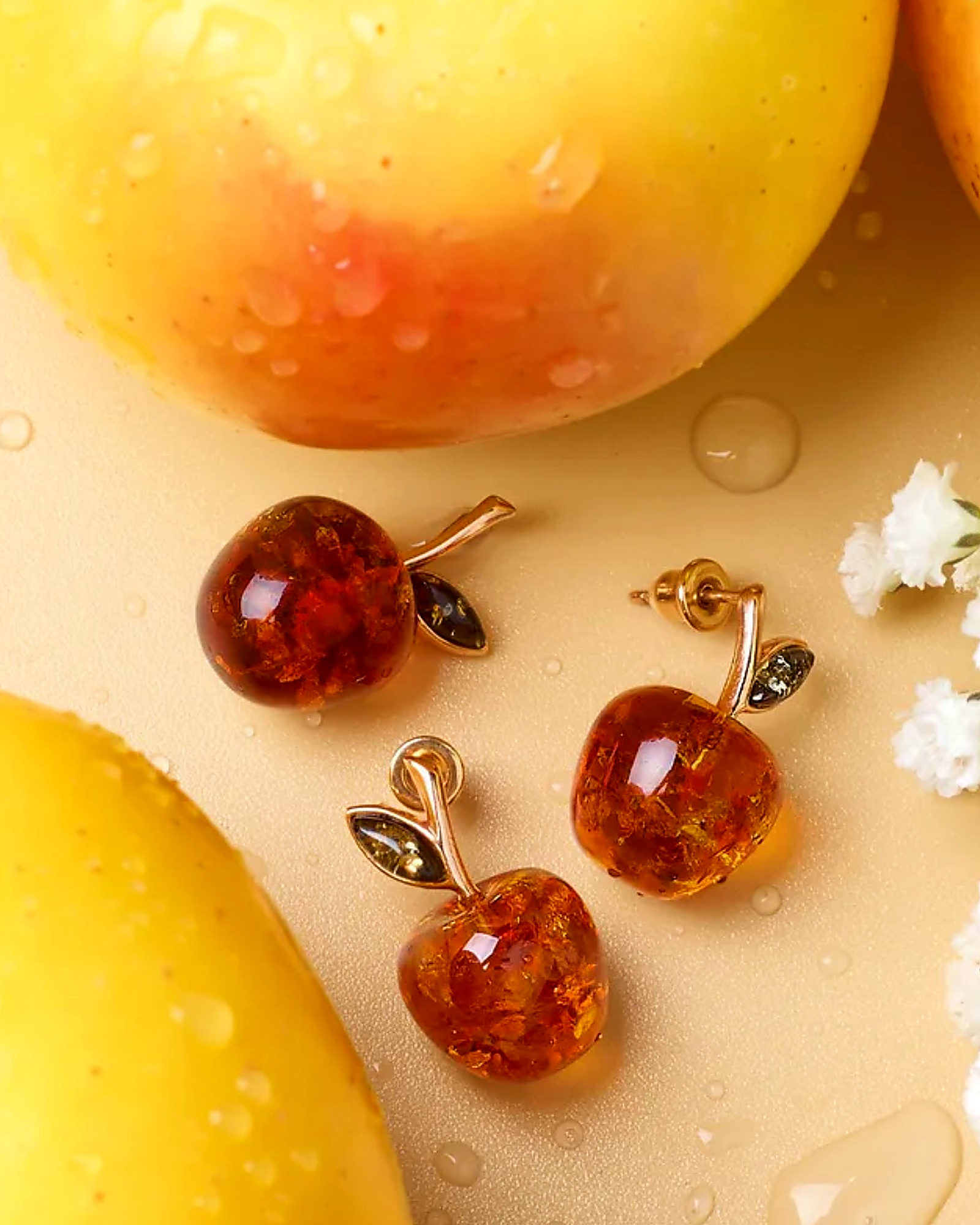
What it is
Resin, hardened by time.
Amber began as resin in ancient forests. Over millions of years it hardened, and the northern sea carried it to the Baltic coast.
It is light, warm to the touch and soft enough to carve. That softness is why it needs gentle care and why no two pieces are identical.
How to read a piece
Colour, inclusions, cut.
Colour
Ranges from honey to near-black. Our cognac amber sits in the deep golden range. Tone varies between pieces, and within one piece.
Inclusions
Small bubbles, plant fragments and darker swirls are natural. They are the clearest sign that the material is amber and not a moulded copy.
Cut and polish
Each apple is carved and polished by hand. Facets are deliberate; a faint irregularity is the trace of the hand, not a defect.
No home test proves origin. Warmth, weight and the look of inclusions help, but provenance is what matters. Ours is the Baltic region, stated on every product page.
Certificate & stamps
What the paper says.
Every order ships with a numbered certificate. It records the piece, its SKU, its metal, its stone and its measurements.
The certificate is signed by the person who finished the piece. It is not a gemological grading report, and we do not claim one.
| 925 | 92.5% silver. Used for our plated pieces and the pineapple pendant. |
|---|---|
| 585 | 58.5% gold, or 14 karat. Used as plating on silver, and as solid white gold in the sapphire studs. |
| Plating | Always stated separately from the metal. Plating is a finish, not solid gold. |
| Assay marks | Where an independent assay mark is required, it is applied by the assay office. We do not invent or imitate one. |
The product page for each piece states its metal and plating. That statement is the one we stand behind.
See the material in the pieces.